What to Do If Car Breaks Down: Safety Tips & When to Call a Tow

If you’re unsure what to do if car breaks down, start with safety: pull over as far left as you can, turn on your hazard lights, and stay inside with your seatbelt on. Only get out if it’s safer to wait behind a barrier, away from traffic. If anyone is in danger, call 000.
What to do if car breaks down: the first 5 minutes
Here is what to do if your car breaks down, in the order that keeps you safest.
- Signal and move left. Indicate and ease towards the left while the car is still moving.
- Get as far off the road as you can. Use the shoulder, an emergency stopping lane or a breakdown lane, and stop well clear of moving traffic.
- Turn on your hazard lights. If visibility is poor, switch on your parking lights too.
- Stay buckled in, or get out on the safe side. NSW Government advice is to stay in your vehicle with your seatbelt on. If you need to get out, check for traffic, exit on the side away from it and stand clear of the road, behind a barrier if it’s safe. Avoid crossing the road.
- Check everyone is OK. If anyone is hurt, unwell or in danger, call 000.
- Work out your exact location. Note the road, direction of travel and nearest cross street, exit, landmark or motorway marker post. Your phone’s map app can help.
- Call for help. Once you’re safe, call a towing or roadside provider.
For a flat battery, flat tyre, empty tank or lockout, roadside assistance can often get you going without a tow.
Car broken down safety tips for different places
What to do when your car breaks down depends on where you’ve stopped. These car broken down safety tips cover the main spots.
On a motorway or high-speed road
The answer to “breakdown on motorway what to do” is to get into the emergency stopping lane or onto the shoulder, far left, with hazard lights on. Stay in the car with your seatbelt on unless there’s a safety barrier you can reach without crossing traffic, and never cross lanes on foot. Breakdown lanes are for breakdowns only; for phone calls, toilet stops or attending to children, use a rest area.
In a tunnel
Pull into a breakdown bay or to the side of the lane, turn on your hazard lights, stay in your vehicle and wait for help. NSW Government advice notes that major tunnels are constantly monitored. If you see smoke or flames, call 000.
On a suburban street or in a car park
Pull in close to the kerb with your hazard lights on, clear of driveways and intersections where you can. If you get out, wait on the footpath well back from the road.
On a country road
On a narrow country road, move as far off the road as possible and turn on your hazard lights. Stop on firm ground, and call as soon as you have signal.
At night
At night, keep your hazard lights and parking lights on and stay inside with the doors locked. If you must get out, wear a high-vis vest and use a torch.
In heat, rain, storms or floodwater
- In storms, avoid stopping under trees or power lines.
- Never drive into floodwater. If you’re caught in it and feel unsafe, call 000.
- On hot days, a stopped car heats up quickly, so keep water handy and call for help early.
With children or pets in the car
Keep children and pets restrained in the car beside traffic, unless it’s safer to move everyone behind a barrier together. Never leave them alone in the car; on hot days a parked car heats up quickly. If a child or pet is locked in a car, call 000.
Staying safe while waiting for a tow truck
Staying safe while waiting for a tow truck comes down to where you wait and who you open the door to.
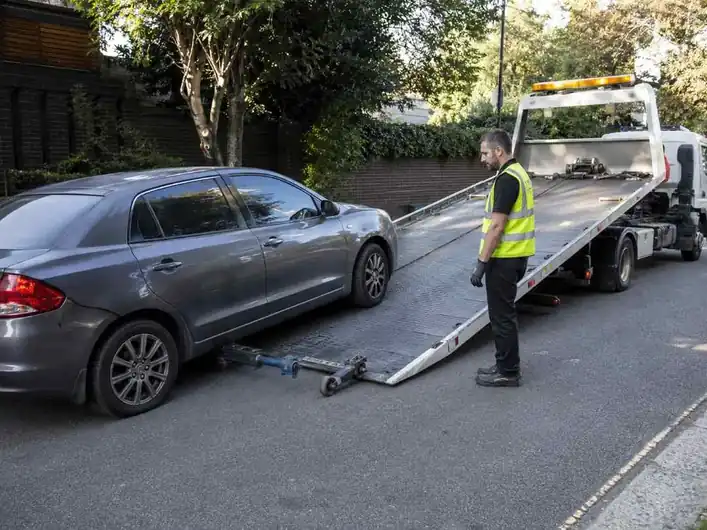
- Wait in the car with your seatbelt on, or behind a safety barrier. Don’t stand behind the car or between it and traffic, including while it’s being loaded.
- Keep your hazard lights on, and wear a high-vis vest if you step out.
- At night, keep the doors locked until your operator arrives.
- Confirm the operator’s name or company before you hand over keys, and politely decline any tow you didn’t request.
- Keep your phone charged.
When passing a stopped tow truck or breakdown vehicle with flashing lights, NSW drivers need to slow to 40 km/h where the limit is 80 km/h or less, and slow down safely and move over a lane if it’s safe where the limit is over 80 km/h. This is general information, not legal advice, and rules can change; see the NSW Government breakdown safety advice.
Emergency towing situations: when to stop and call for a tow
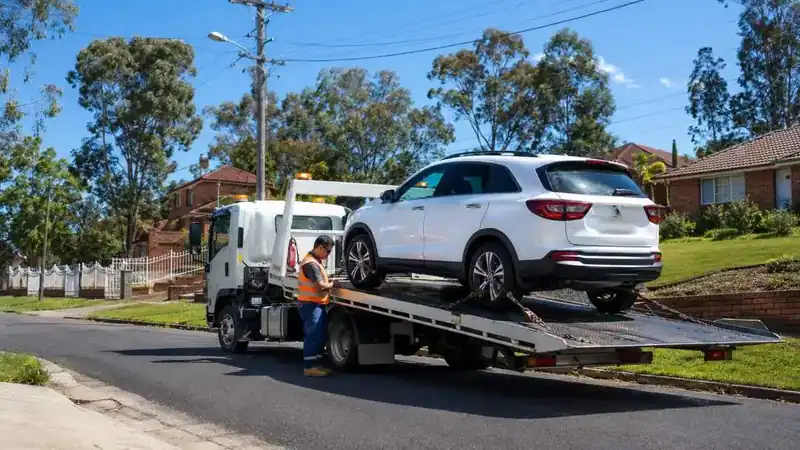
In these emergency towing situations, don’t drive on or try a fix: stop where it’s safe and book a tow, calling 000 first where noted.
| Situation | Why it’s an emergency | What to do |
|---|---|---|
| Stopped in a live traffic lane or tunnel | Others may not see you in time | Hazard lights on, stay buckled in. If you can’t get clear safely, call 000. |
| Smoke, flames or a fuel smell | Risk of fire | Get everyone out on the side away from traffic, move well away and call 000 first. |
| Temperature gauge in the red or steam from the bonnet | Driving on can seriously damage the engine | Pull over and switch off. Don’t open the radiator cap while hot. |
| Oil pressure or red engine warning light | It can signal a problem that damages the engine quickly | Stop when it’s safe, switch off and check your owner’s manual. Don’t drive on. |
| Brakes or steering feel wrong | You may not be able to stop or control the car | Stop as soon as it’s safe and don’t drive further. |
| Flat or damaged tyre with no usable spare, or a damaged wheel | The car can’t be driven safely | Don’t drive on it. Book a tilt tray to a tyre shop or mechanic. |
| Wrong fuel in the tank | Running the engine spreads the wrong fuel through the system | Don’t start the engine, or switch off as soon as you notice. Book a tow. |
| Car won’t start in an unsafe spot at night | You’re exposed to traffic and poor visibility | Stay inside, doors locked, hazards on, and call for help. |
| Car stalled in floodwater | Restarting can cause severe engine damage | Don’t restart it. If you’re in danger, call 000. |
For any of these, our team can help with car towing in Sydney and the Illawarra on a tilt tray.
Common roadside emergencies: fix on the spot or tow?
Many common roadside emergencies can be sorted on the spot, but some need a tow. This is a general guide only.
| Problem | Can it usually be fixed at the roadside? | When it needs a tow |
|---|---|---|
| Flat battery | Often, with a jump start | The battery won’t hold a charge, or the charging system is faulty |
| Flat tyre | Often, if there’s a usable spare and a safe place to change it | No usable spare, a damaged wheel, or nowhere safe to work |
| Out of fuel | Usually, with a fuel delivery | The car still won’t start after refuelling |
| Locked out | Often, with a lockout service | The keys are lost or damaged and a new key is needed |
| Overheating | Sometimes, once cool and the cause is clear | It overheats again or there’s a leak |
| Warning light or limp mode | Depends on the light; check your owner’s manual | A red warning light, or limp mode far from a mechanic |
| Alternator failure | Rarely; a jump start may only last a short distance | Usually, because the battery will drain again |
For the full steps on an empty tank, read what to do when your car runs out of fuel.
What to tell the tow truck operator when you call
The right details help the operator send the right truck for your broken down car.
- Your exact location and direction of travel
- The make and model, and whether it’s an EV, hybrid, AWD or 4WD
- What happened and any warning lights
- Whether the car rolls, steers and brakes
- Whether you have the keys
- Where you want it taken: a mechanic, dealer, home or storage
- How many people are with the car
- Any trailer, caravan or boat trailer attached
You get a clear quote before we dispatch. The price depends on your vehicle, the distance and the time of day, and any after-hours rate is confirmed upfront.
How to reduce your chance of breaking down
Regular checks prevent many breakdowns.
- Refill before the tank gets low.
- Check oil and coolant levels regularly.
- Check tyre pressure, including the spare.
- Have an ageing battery tested, especially if the car is slow to start.
- Keep up with servicing.
- Don’t ignore warning lights.
Keep a kit in the car: a high-visibility vest, torch, phone charger, water, first-aid kit and your owner’s manual. For a fuller routine, see our guide to car safety checks.
When to call AH Towing Services
Once you know what to do if your car breaks down and you’re safely off the road, call AH Towing Services. For jump starts, flat tyre changes with a usable spare, fuel delivery and lockouts, our team can often fix it at the roadside.
If it can’t be fixed safely on the spot, we tow on a tilt tray to your mechanic, dealer, home or storage. That includes non-running cars, EVs, hybrids and AWD/4WD vehicles, plus motorcycles, caravans and boat trailers.
We cover Greater Sydney and the Illawarra, including car towing in Parramatta. Available 24/7, including weekends and public holidays.
Frequently asked questions
Should I stay in my car if it breaks down?
In most cases, yes. NSW Government advice is to stay in your vehicle with your seatbelt on and call for help. Get out only if it’s safer, such as when there’s smoke or a fuel smell, or a barrier you can reach without crossing traffic, and exit on the side away from traffic.
What should I do if my car breaks down on the motorway?
Move into the emergency stopping lane or onto the shoulder, as far left as you can, and turn on your hazard lights. Stay in the car with your seatbelt on unless you can safely wait behind a barrier. Note the nearest exit or marker post for your call.
What should I do if my car breaks down in a tunnel?
Pull into a breakdown bay or to the side of the lane, turn on your hazard lights and stay in your vehicle. Major tunnels are constantly monitored. If there’s smoke or flames, call 000.
Is it safe to change a tyre on the side of the road?
Only if you’re well away from traffic on firm, level ground. NSW Government advice is to move to a safe spot away from traffic if possible and not change a tyre unless it’s safe. On a motorway or narrow shoulder, wait in the car and call for help.
What counts as an emergency tow?
It’s when the car can’t be driven safely or is stopped somewhere risky. Examples include faulty brakes or steering, a red warning light, overheating, wrong fuel, floodwater, or being stuck in a live lane. If anyone is in danger, call 000 first.
Can I get a tow if I’m not a roadside assistance member?
Yes. You can call a towing company like AH Towing Services directly, with no membership needed. You get a clear quote before we dispatch. The price depends on your vehicle, the distance and the time of day, and any after-hours rate is confirmed upfront.
Broken down in Sydney or the Illawarra? Call 0420 502 202 or get a free quote. Available 24/7, including weekends and public holidays. If anyone is in danger, call 000 first.