How to Tow a Car With a Car Safely in NSW

How to tow a car with a car comes down to four things: a licensed driver in the towed car to steer and brake, working brakes and steering, a proper tow strap and the right tow points. In NSW you can usually tow a broken-down car this way for a short distance, as long as you follow the road rules and set it up properly.
It’s a reasonable option for moving a car a few streets on quiet roads. For anything longer, faster or hillier, or if the car has no brakes or locked steering, a tow truck is the safer and usually simpler choice.
Key takeaways
- DIY towing suits short, slow moves on quiet local streets.
- A licensed, confident driver must sit in the towed car to steer and brake.
- Use a rated tow strap and the manufacturer’s tow points, never bumpers or suspension.
- Keep the line short and make it easy for other drivers to see.
- Many automatic, AWD, hybrid and electric cars can be damaged if towed with their wheels on the ground. Check the owner’s manual first.
- No brakes, locked steering, a motorway or a long trip? Call a professional.
Is it legal to tow a car in NSW?
Towing another car is something NSW road rules allow for, but the rules still apply to both cars. Treat the towed car as if you’re driving it: it needs a licensed driver in the seat, plus working brakes, steering and lights.
The rules also cover how the two cars are connected and making the towline visible to other road users. Because details and penalties can change, check Transport for NSW’s current guidance on towing before you set off. If you’re not sure your setup ticks every box, that’s a good sign to call a tow truck instead.
Ways to tow a car: rope, tow bar, trailer or tow truck
| Method | How it works | Best for | Main drawbacks |
|---|---|---|---|
| Tow rope or strap | A flexible line between the two cars’ tow points | Moving a car a short distance on quiet streets | The towed driver must do most of the braking; the line can go slack or snap |
| Rigid tow bar (A-frame) | A solid bar keeps the cars a fixed distance apart | Regular or slightly longer towing with a suitable car | Needs proper mounting points, and not every car can be towed this way. Check with the manufacturer |
| Car trailer or tow dolly | The car sits fully on a trailer, or front wheels up on a dolly | Longer distances; autos and AWDs (full trailer) | Needs a towing vehicle rated for the combined weight, plus loading know-how |
| Tow truck (tilt tray) | The car is winched onto the truck’s deck | Cars with no brakes, locked steering, autos, AWDs, long trips | A cost, though a good operator quotes it upfront |
Tow bar vs tow rope: a rigid bar stops the towed car from running up behind you when you brake, which makes it much more forgiving than a rope. A rope or strap is cheap and fits in the boot, but the person in the towed car has to brake at the right moment to keep the line tight. For a one-off move of a few hundred metres, a strap is fine. For anything more, the rope is usually the wrong tool.
Check these before you hook anything up
Most problems we see with DIY tows start before the cars even move. Five minutes of checks saves a lot of grief.
Can the towing car handle the weight?
Look up the towing car’s towing capacity in the owner’s manual or on the manufacturer’s website. The NSW Government’s towing guidance is clear that manufacturer towing limits shouldn’t be exceeded. A small hatchback pulling a large SUV or ute puts heavy strain on its clutch, transmission and brakes, and it will take much longer to stop. As a rule of thumb, the towing car should be the same size or bigger than the car being towed.
Find the proper tow points
Most modern cars have a screw-in tow eye stored with the jack or spare-wheel kit. It threads into a small covered hole in the front or rear bumper cover. Some older cars and 4WDs have fixed tow hooks on the chassis.
Never tie onto the plastic bumper, suspension arms, steering parts, the exhaust or a roof rack. They aren’t built for pulling loads and can bend or tear off. Looping a strap over a tow ball isn’t ideal either, as it can slip off when the line goes slack.
Do the brakes and steering actually work?
With the engine off, there’s no power assistance. The brake pedal goes very hard and the steering gets heavy, so the person in the towed car needs to be ready to push much harder than usual.
Turn the key or press start to the accessory position so the steering lock releases. If the battery is completely flat, some cars (especially push-button models) won’t unlock the steering or let you select neutral. If the wheel won’t turn freely, don’t tow it.
Is it an automatic, AWD, hybrid or EV?
Many automatic gearboxes only circulate oil while the engine is running. Towing one with the drive wheels on the ground can overheat it and cause expensive damage. Some manufacturers allow a short, slow tow in neutral; many say not at all.
All-wheel-drive cars can damage their centre differential or transfer case if towed with some wheels on the ground. Hybrids and EVs can have their electric motors driven by the wheels, which many manufacturers say to avoid.
The owner’s manual will have a “towing” or “emergency towing” section. If it says the car must be carried on a flatbed, take that seriously.
How to tow a car with a car: step by step
This method is for a short tow, such as getting a car off a busy road or a few streets home. Read it through with the other driver before you start.
- Plan a short, quiet route. Pick the shortest way on local streets with no steep hills and as few turns and roundabouts as possible.
- Use a proper tow strap. Choose one rated well above the towed car’s weight. Avoid old rope, and don’t use a snatch strap: it’s designed to stretch for off-road recovery, not for towing on the road.
- Attach it to the correct tow points. Keep the line straight between the cars and the gap short: enough room for the towed car to stop, but close enough to stay in control.
- Make the line visible. Tie a brightly coloured cloth or flag to the middle so other drivers can see it and don’t try to cut between the cars.
- Set up the towed car. A licensed driver sits in the driver’s seat. Ignition to accessory so the steering unlocks, gear in neutral, handbrake off, hazard lights on (and headlights if it’s getting dark).
- Agree on signals first. For example, the towed driver flashes the headlights or taps the horn to ask you to stop. Sort this out before you move rather than relying on phone calls mid-tow.
- Take up the slack slowly. Creep forward until the strap is tight, then pull away gently. A sudden jerk can snap the strap or pull out a tow point.
- Keep it slow. Stay well below the posted limit, at a speed where both drivers feel fully in control. Slower is always better with a rope.
- Keep the line taut. The towed driver should brake lightly to keep tension on the strap. A slack line can catch under a wheel, then snap tight with a jolt.
- Brake early and gently. The towing driver should signal early and slow down gradually. Leave much more stopping distance than normal, because the towed driver is doing most of the stopping with unassisted brakes.
- Take corners wide. The towed car cuts inside your line on turns, so swing a little wider and slow right down.
When not to tow a car with another car
DIY towing is reasonable for a short, flat, quiet run. Skip it and get a professional if:
- The route uses a motorway or fast main road. Traffic is far too fast for a rope tow, and there’s often nowhere safe to stop.
- There are steep hills. Going down, the towed car can run up on you; going up, the towing car can struggle and overheat its clutch.
- It’s more than a few kilometres. The longer the trip, the more chances for something to go wrong.
- The brakes don’t work or the pedal goes to the floor.
- The steering is locked, stiff or damaged.
- The towed car is heavier than the towing car, or it’s a large van, 4WD or loaded ute.
- The owner’s manual says no flat towing (common with autos, AWDs, hybrids and EVs).
- The person steering the towed car is inexperienced or nervous. It’s harder work than normal driving.
- It’s dark or raining heavily, which cuts visibility and stopping grip.
The risks of towing a car yourself
Damage to either car. The most common outcomes are a damaged automatic gearbox, a cooked clutch on the towing car, a ripped-out tow eye or bumper cover, and a strap that snaps under load.
Insurance and liability. Your car insurance may not cover damage caused while towing or being towed by a private vehicle. Check your policy’s Product Disclosure Statement, or call your insurer before you hook up. If something goes wrong, both drivers may be held responsible.
Fines. Breaking road rules while towing can lead to fines on top of any repair bill. If you’re unsure, check Transport for NSW’s towing guidance first.
When a professional tow is the simpler choice
Sometimes the honest answer is that a DIY tow isn’t worth the risk. If the car won’t start because of a flat battery or a flat tyre, roadside assistance can often get you going on the spot, with no tow needed. Not sure which you need? Our guide on roadside assistance vs towing explains the difference.
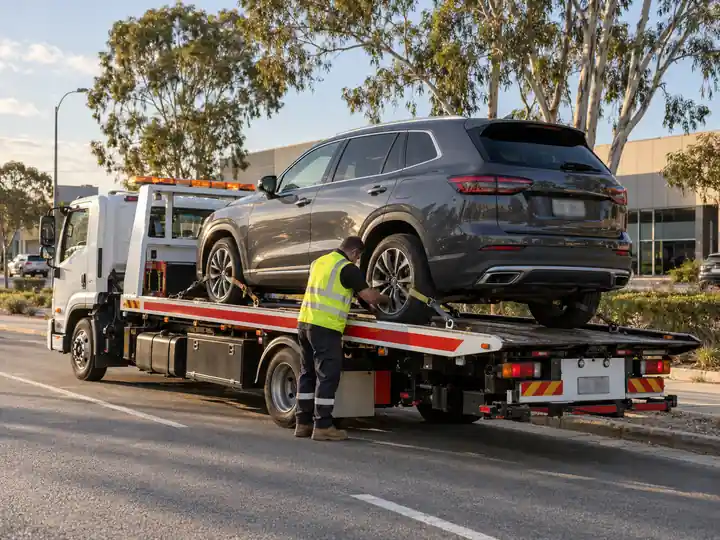
For cars with mechanical failure, warning lights, no brakes, locked steering, or an automatic or AWD drivetrain, a tilt-tray tow keeps all four wheels off the road and removes the guesswork. Our car towing service covers greater Sydney, with typical metro response times of 30–60 minutes depending on location and traffic.
If the car isn’t worth repairing, our unwanted car removal service can take it away instead. Costs for any tow depend on distance, vehicle type and time of day, so the easiest way to know is to get a free quote.
FAQs
Can I tow a car with a rope in NSW?
Generally, yes, for a short distance, as long as the towed car has a licensed driver, working brakes and steering, and you follow NSW road rules on how the cars are connected. A purpose-made tow strap is safer than general-purpose rope.
How far can you tow a car with another car?
Keep it as short as possible. A rope tow is best for moving a car a short distance on quiet local roads. For anything longer, use a trailer or a tow truck.
Can you tow an automatic car with another car?
Often not without risk. Many automatics can be damaged if towed with the drive wheels on the ground, even in neutral. Check the towing section of the owner’s manual. If it says flatbed only, use a tilt tray.
Do I need a tow bar to tow another car?
No. A rated tow strap attached to the proper tow points on both cars can be used for a short tow. A rigid tow bar is more stable and forgiving, but it needs suitable mounting points and isn’t common for one-off moves.
Does the person in the towed car need a licence?
Yes. They’re steering and braking a car on a public road, so they need to be a licensed, confident driver.
Is it cheaper to tow it myself?
It can be, if everything goes to plan. But a damaged gearbox, a broken tow point or an uninsured mishap can cost far more than a professional tow. If you’re unsure, a free quote costs nothing.
Need a hand moving a broken-down car?
If your car has stopped and a DIY tow doesn’t feel right, we can help. AH Towing Services operates 24/7 across greater Sydney, including public holidays, with licensed and insured operators and upfront quotes.
Call 0420 502 202, message us on WhatsApp, or request a free quote and we’ll take it from there.