Towing Capacity Australia: How Much Can You Legally Tow?

Towing capacity Australia rules start with the vehicle maker’s figure: the maximum loaded trailer weight your car is rated to tow. In NSW, a loaded trailer must not weigh more than the lowest of the vehicle’s towing capacity, the towbar’s rating, the trailer’s own carrying capacity and its tyres’ load rating.
Below, we explain how towing capacity in Australia works: braked and unbraked limits, the weight terms on your plates, a worked example and the NSW Government rules.
What is towing capacity in Australia?
Towing capacity in Australia is the maximum loaded weight of a trailer or caravan that the vehicle maker says your vehicle can tow. It’s listed in the owner’s manual, and you can’t raise it yourself. It’s only one of several limits.
Braked towing capacity
Braked towing capacity is the maker’s maximum for a trailer or caravan with its own working brakes. It only applies when the trailer’s brakes are connected and working.
Unbraked towing capacity
Unbraked towing capacity is the maker’s maximum for a trailer without brakes. It can never be more than 750 kg, because NSW rules require brakes on heavier trailers, and on many cars it’s lower.
| Trailer mass | Brakes required in NSW |
|---|---|
| Up to 750 kg | None required (any brakes fitted must work) |
| 751–2,000 kg | Brakes on both wheels of at least one axle |
| 2,001–4,500 kg | Brakes on all wheels, plus a breakaway system (required over 2 tonnes) |
Towing weights explained: the numbers you need to know
Your car’s towing capacity is only one of these ratings. You need them all to find your real limit.
| Term | What it means | Where to find it |
|---|---|---|
| Tare | Empty trailer or caravan, with a little fuel and no load or water | Trailer compliance plate |
| Kerb weight | Empty vehicle with fluids and fuel (full or a maker-set level), no passengers or cargo | Owner’s manual |
| Gross Vehicle Mass (GVM) | Most the tow vehicle may weigh fully loaded, with passengers, cargo, accessories and tow ball download | Vehicle compliance or build plate; owner’s manual |
| Payload | GVM minus the vehicle’s actual unloaded weight; accessories use it up | GVM minus your weighed vehicle |
| Aggregate Trailer Mass (ATM) | Most the trailer may weigh fully loaded, including the weight on the tow ball | Trailer compliance plate |
| Gross Trailer Mass (GTM) | Weight on the trailer’s own axles when hitched (ATM minus tow ball download) | Trailer maker’s specifications |
| Tow ball mass (TBM) | Downward weight the trailer puts on the tow ball (tow ball download). It counts toward GVM and payload | Owner’s manual (maximum); tow ball scale (actual) |
| Gross Combination Mass (GCM) | Most the tow vehicle and trailer may weigh together | Owner’s manual or maker’s specifications |
| Towing capacity | Maker’s maximum loaded trailer weight, braked or unbraked | Owner’s manual; the towbar has its own rating |
The GCM trap: on many vehicles, GVM plus braked towing capacity adds up to more than the GCM, so you often can’t tow the maximum and load your vehicle to its GVM at the same time.
How to calculate towing capacity: a worked example
To calculate towing capacity, check each limit separately with weighed figures. These numbers are example only – use your own vehicle’s figures.
The example tow vehicle has a GVM of 3,100 kg, a GCM of 6,000 kg, a braked towing capacity of 3,500 kg and a maximum tow ball mass of 350 kg. The GCM trap shows straight away: 3,100 kg plus 3,500 kg is 6,600 kg, which is 600 kg more than the GCM.
Loaded with people, fuel, gear and accessories, the vehicle weighs 2,750 kg before hitching. The loaded caravan weighs 3,200 kg (within its ATM), with a 300 kg tow ball download.
| Check | Calculation | Result |
|---|---|---|
| 1. Trailer vs towing capacity | 3,200 kg ≤ 3,500 kg | ✓ Pass |
| 2. Tow ball download vs maximum | 300 kg ≤ 350 kg | ✓ Pass |
| 3. Vehicle vs GVM once hitched | 2,750 + 300 = 3,050 kg ≤ 3,100 kg | ✓ Pass |
| 4. Combination vs GCM | 2,750 + 3,200 = 5,950 kg ≤ 6,000 kg | ✓ Pass (only 50 kg spare) |
Add 200 kg more gear to the vehicle:
- Vehicle once hitched: 2,950 + 300 = 3,250 kg, more than the 3,100 kg GVM ✗
- Combination: 2,950 + 3,200 = 6,150 kg, more than the 6,000 kg GCM ✗
The setup is now over its limits, though the caravan didn’t change. Finally, run the NSW “lowest rating” check: the towbar rating and the caravan’s tyres must also cover 3,200 kg, and the tow coupling must cover the tow ball download.
The lowest of all these limits is your real towing capacity.
NSW rules on how much you can tow
In NSW, the lowest rating sets your limit, and other rules cover speed, licences, towbars and chains:
- The loaded trailer must not weigh more than the lowest of: the towbar and tow coupling’s rated capacity, the vehicle’s maximum towing capacity, the trailer’s maximum carrying capacity, and the maximum rated carrying capacity of its tyres.
- If the maker hasn’t set a maximum towing capacity, the limit is 1.5 times the tow vehicle’s unladen mass for a trailer with working, connected brakes, or the vehicle’s unladen mass if the trailer doesn’t need brakes.
- If the vehicle’s GVM or the combination’s GCM is more than 4.5 tonnes, you must not exceed 100 km/h while towing, even where the posted limit is higher. Lower limits set by the maker, the road, traffic or weather also apply.
- Tow only one trailer at a time, and no one may ride in a trailer or caravan while it’s being towed.
- Learner drivers must not tow. P1 drivers may tow only a light trailer with an unloaded mass of up to 250 kg.
- Towbars on vehicles built after 1 January 1992 must be permanently marked with their rated capacity, and that rating must not be exceeded.
- Trailers up to 2,500 kg loaded need at least one safety chain. Trailers over 2,500 kg need two chains, crossed.
These points summarise the NSW Government towing rules. They’re general information, not legal advice, and can change, so check the source. Outside NSW, check your state’s transport authority, as rules differ.
For the wider legal picture, see our guide to towing laws in Australia.
Where to find your vehicle and trailer weights
Your ratings are printed in five places:
- The owner’s manual (your vehicle’s towing capacity, tow ball mass, GVM and GCM)
- The vehicle’s compliance or build plate, often on the door pillar or under the bonnet
- The towbar’s capacity plate or label
- The caravan or trailer’s compliance plate (tare and ATM)
- The load rating on each tyre’s sidewall
Only weighing tells you where you are. Take the loaded vehicle and the loaded caravan or trailer to a public weighbridge, and measure the tow ball download with a tow ball scale.
How to load a caravan or trailer for safe towing
How you load matters as much as how much you load:
- Keep heavy items low, close to the axle and towards the centre.
- Place about 60% of the load ahead of the axle centre.
- Aim for about 5–10% of the loaded trailer’s mass on the coupling, within your vehicle’s maximum tow ball mass.
- Keep the drawbar level or slightly nose-down.
- Secure and cover the load.
- Attach the safety chains correctly, crossed when two are required.
Large caravans may need extra mirrors, and some vehicles need a load-distribution device or a transmission oil cooler, so check with your vehicle and towbar makers. If you drive an automatic, read our guide to towing a caravan with an automatic car.
Common towing capacity mistakes
- Trusting the advertised maximum. It ignores GCM and payload.
- Forgetting accessories and passengers. They all use up payload.
- Ignoring tow ball download. It counts toward GVM.
- Reading tare instead of loaded weight. Tare is the empty caravan.
- Forgetting water, gas and gear. They add up quickly.
- Forgetting the towbar’s rating. A lower-rated towbar sets the limit.
- Assuming the unbraked limit is always 750 kg. Many cars are rated lower.
- Never weighing the rig. Guessing isn’t checking.
Safety: when to stop and get help
Stop and reassess if your rig doesn’t feel right. Sway, a noticeably sagging rear, a light-feeling front end and weak braking are signs of an overloaded or unbalanced setup, so slow down gradually and pull over somewhere safe.
Don’t keep driving an unsafe or faulty combination. If a tyre, wheel bearing, coupling or hitch fails, or the tow vehicle breaks down, pull over somewhere safe, turn on your hazard lights and call for help. If anyone is in danger, call 000 first.
When to call Towing Services
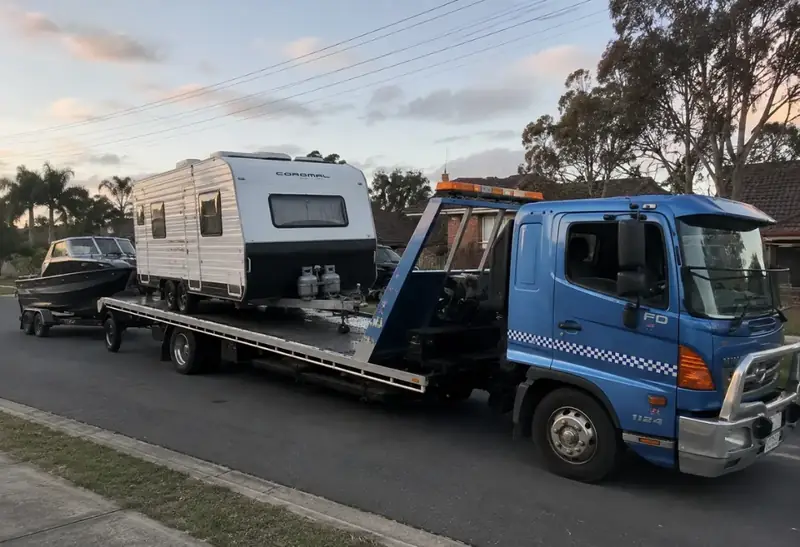
Call AH Towing Services when your caravan, boat trailer or camper trailer can’t be towed safely, such as after a failed coupling, a damaged wheel or bearing, or a tow vehicle breakdown. We can move it on a tow truck to a workshop, your home, storage or a marina. Tell us its size and weight when you call.
Our caravan and boat towing covers caravans, camper trailers, boat trailers, tinnies and jet skis across Greater Sydney and the Illawarra, plus long-distance towing across NSW.
If the tow vehicle has a flat battery or a flat tyre, our roadside assistance team may get you going with a jump start, or a tyre change when there’s a usable spare.
Available 24/7, including weekends and public holidays. You get a clear quote before we dispatch. The price depends on your vehicle, the distance and the time of day, and any after-hours rate is confirmed upfront.
Towing Capacity Australia: Frequently Asked Questions
Can I increase my car’s towing capacity?
No. Towing capacity is set by the vehicle maker, and a higher-rated towbar doesn’t change the vehicle’s figure. Any change to a vehicle’s GVM or GCM is a specialist area involving an approved, certified modification, so talk to your vehicle maker first.
Does tow ball weight count towards GVM?
Yes. The tow ball download rests on your vehicle, so it counts toward your GVM and uses up payload.
What happens if I tow over my towing capacity?
You’d be towing over a legal limit, and the combination becomes less stable, more prone to sway and harder to stop. Don’t do it: lighten the load or use a vehicle rated for the weight.
Do I need trailer brakes over 750 kg in NSW?
Yes. Trailers from 751 kg to 2,000 kg need brakes on both wheels of at least one axle, and trailers from 2,001 kg to 4,500 kg need brakes on all wheels. Trailers over 2 tonnes also need a breakaway system.
Can P-platers tow a trailer in NSW?
P1 drivers can tow only a light trailer with an unloaded mass of up to 250 kg, and learner drivers can’t tow at all. For P2 and other licences, check the current NSW Government licence conditions.
How much can my car tow?
Start with your car’s towing capacity, braked and unbraked, in the owner’s manual and on the vehicle’s plates. Then check the towbar rating, the trailer’s ATM and tyre ratings, your maximum tow ball mass and your GCM. The lowest of these limits is how much your car can legally tow.
Caravan, boat or trailer stuck in Sydney? Call 0420 502 202 or get a free quote. Available 24/7, including weekends and public holidays. If anyone is in danger, call 000 first.


