Run Flat Tyres: What They Are, How Far You Can Drive?

Run flat tyres are tyres built to keep your car moving for a short distance after a puncture. Stiff, reinforced sidewalls (or an internal support ring) hold the car up when the air is gone. As a typical guide, you can drive about 80 km at up to 80 km/h, but always check your owner’s manual.
Knowing whether your car has run flats matters. Many cars fitted with them carry no spare tyre, and a deflated run flat may not look flat at all.
What are run flat tyres?
Run flat tyres are tyres designed to support your car for a limited distance after losing air pressure. The run flat tyres meaning is in the name: the tyre can still run while flat. A standard tyre needs air to hold its shape, so it collapses when punctured.
There are three main designs you’ll hear about:
- Self-supporting run flats: the most common type on passenger cars. Thick, reinforced sidewalls hold the car up when pressure drops.
- Support-ring systems: a hard ring fitted inside the tyre, on the wheel, carries the weight if the tyre deflates.
- Self-sealing tyres: a lining inside the tread can seal small punctures as they happen. These are not true run flats, because they can’t carry the car once the air has gone.
Whichever type you have, a run flat tyre gets you somewhere safe; it isn’t a permanent fix. AH Towing Services covers jump start and flat tyre help as part of our roadside service.
How do run flat tyres work?
Run flat tyres work by moving the load from the air inside the tyre to the tyre’s structure. In a self-supporting tyre, the reinforced sidewalls stay upright when the pressure falls to zero. In a support-ring system, the ring takes the weight.
Because the tyre keeps its shape, you may not notice a puncture by looking at it or by how the car feels. That’s why cars fitted with run flats rely on a tyre pressure monitoring system (TPMS) or a tyre warning light to tell you when pressure has dropped. If that warning comes on, treat it as a countdown, not a suggestion.
How to tell if your car has run flat tyres
The quickest way to tell is to read the sidewall of the tyre. Most makers print a code or symbol next to the tyre size. The markings below are common, but they vary by brand.
| Marking | Stands for | Notes |
|---|---|---|
| RFT | Run Flat Tyre | General marking used by several brands |
| ROF | Run On Flat | Self-supporting design |
| ZP | Zero Pressure | Runs at zero pressure for a limited distance |
| SSR | Self-Supporting Runflat | Reinforced sidewalls |
| EMT | Extended Mobility Technology | Self-supporting design |
| DSST | Dunlop Self-Supporting Technology | Dunlop’s run flat design |
| RSC | Runflat System Component | Used on BMW-approved run flats |
Don’t confuse these codes with the BMW star (★). The star means BMW has approved that tyre for the model. It doesn’t, by itself, mean the tyre is a run flat, and many star-marked tyres are standard tyres.
Two other checks help. Your owner’s manual lists the tyres the car was built to use. And if the boot has no spare wheel, only an inflator kit or an empty space, the car probably came with run flats.
How far can you drive on a run flat tyre?
As a typical guide, you can drive about 80 km at up to 80 km/h on a deflated run flat tyre. The real limit depends on the tyre maker and your vehicle, so check the owner’s manual and the tyre maker’s guidance for your exact figure.
Several things can shorten that distance:
- Load: a full car or a loaded boot puts more weight on the weakened tyre.
- Heat: a deflated tyre heats up as it flexes, and hot days add to it.
- Speed: going faster builds heat more quickly.
- Damage: a cut, bulge or large hole can mean the tyre isn’t safe to drive on at all.
Standard tyres are different. If your car has regular tyres, read our guide on can you drive with a flat tyre before you move the car.
Run flat tyres vs standard tyres
Run flat tyres trade some comfort and cost for the ability to keep moving after a puncture. Here’s how they compare with standard and self-sealing tyres.
| Run flat | Standard tyre | Self-sealing tyre | |
|---|---|---|---|
| Driving after a puncture | Yes, for a limited distance and speed | No, stop and change or get help | Only if the lining seals a small tread puncture |
| Spare needed | Often no spare fitted | Spare or inflator kit recommended | Spare or kit still recommended |
| Ride comfort | Usually firmer and noisier | Usually softer and quieter | Similar to standard |
| Repairability | Often replaced rather than repaired | Small tread punctures often repairable | Depends on the tyre maker |
| Availability | Fewer sizes in stock, may need ordering | Widely stocked | Less widely stocked |
| Typical cost | Usually higher | Usually lower | Usually higher than standard |
Pros of run flat tyres:
- You can keep driving to a tyre shop or a safer place instead of changing a wheel on a busy roadside.
- No spare wheel is needed, which saves boot space and weight.
Cons of run flat tyres:
- A firmer ride and more road noise.
- Usually a higher price, and the tyres are heavier.
- Fewer sizes kept in stock, so a replacement may need to be ordered in.
Can run flat tyres be repaired?
Sometimes, but often the answer is replacement. Many tyre makers and shops advise replacing a run flat that has been driven on while deflated, because the inside of the tyre can be damaged in ways you can’t see. Any sidewall damage also usually means replacement.
Some makers allow a repair of a small puncture in the tread area, as long as the tyre wasn’t driven flat. The tyre shop inspects the tyre and makes that call, so tell them how far and how fast you drove after the warning came on.
BMW run flat tyres
BMW has fitted run flat tyres to many of its models for years, and Mercedes-Benz, Mini and some Lexus models have used them too. Drivers can keep moving after a puncture, and the car doesn’t need a spare wheel.
If you drive a BMW, look for the RSC marking on the sidewall to confirm a run flat. The star (★) on its own only tells you the tyre is BMW-approved for that model.
Switching a BMW to standard tyres is generally possible. If you do, fit the same type on all four wheels, keep the TPMS working, and carry a spare or an inflator kit. Get advice from a tyre professional or your dealer first, because suspension tuning and wheel fitment can matter.
Once you carry a spare, learn how to change a tyre safely. If you’re keeping run flats, check the boot now: you may have an inflator kit or nothing at all.
What to do if your run flat tyre goes flat
When the tyre warning comes on, stay calm and follow these steps:
- Don’t brake hard. Ease off the accelerator and slow down smoothly.
- Avoid sudden steering, and keep both hands on the wheel.
- Check the warning on your dashboard, then the distance and speed limit in your owner’s manual once you can safely do so.
- Drive gently to a tyre shop or a safe place to stop, staying within that limit.
- Avoid motorway speeds. Stick to roads where you can keep below the limit safely.
- Book a replacement tyre. Run flats may need to be ordered in, so call ahead.
- Get towed if you’re past the limit or the tyre is damaged. Don’t keep driving to “just make it”.
When it’s not safe to keep driving
Stop driving on a run flat tyre if any of these apply:
- You can see a bulge, cut or tear in the sidewall.
- You feel thumping, shaking or strong vibration.
- The steering pulls hard to one side.
- You smell burning rubber.
- You’ve gone past the distance or speed limit in your owner’s manual.
- More than one tyre has lost pressure.
- It isn’t safe where you are to keep going.
Pull over somewhere safe, switch on your hazard lights and stay clear of traffic. If you’re in danger or stopped in a dangerous spot where you’re blocking traffic, call 000. The NSW Government breakdown safety advice covers how to stop and wait safely.
When to call for roadside help or a tow
Roadside help can change a tyre only if your car has a usable spare. If you’ve switched to standard tyres and carry a spare, we can fit it on the spot so you can drive to a tyre shop.
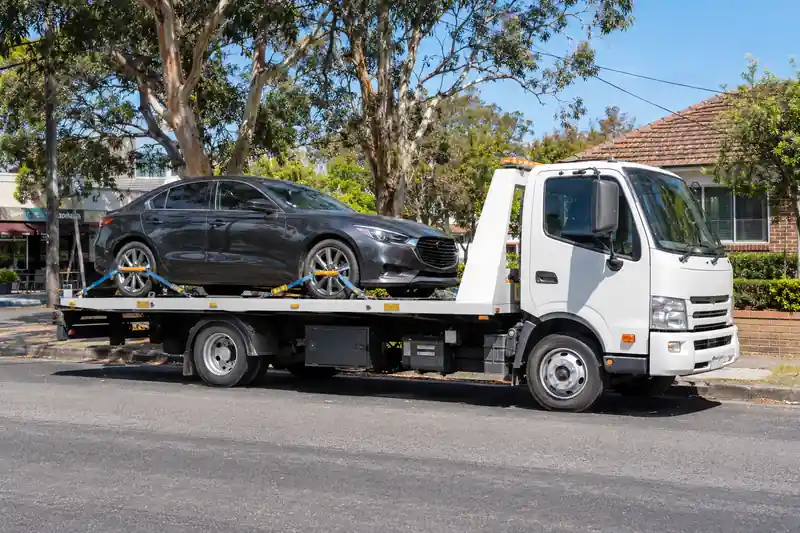
With run flats and no spare, a roadside tyre change usually isn’t possible. If the tyre is past its limit or damaged, the safe option is a tilt-tray tow to a tyre shop, dealer, mechanic or home. Our car towing in Sydney service uses tilt trays, so the car travels with all four wheels off the road.
You get a clear quote before we dispatch. The price depends on your vehicle, the distance and the time of day, and any after-hours rate is confirmed upfront.
Frequently asked questions
What is a run flat tyre, and what does the name mean?
A run flat tyre can keep supporting your car for a limited distance after it loses air. Reinforced sidewalls or an internal ring carry the weight instead of air. It’s designed to get you to a tyre shop or a safer place, not to replace a repair.
Can you put normal tyres on a car that came with run flats?
Yes, switching to standard tyres is generally possible. Fit the same type on all four wheels, keep the tyre pressure monitoring system working, and carry a spare or an inflator kit. Ask a tyre professional or your dealer first, because suspension tuning and wheel fitment can matter.
Can you mix run flat and normal tyres?
No, it’s not recommended. Run flat and standard tyres behave differently, so the usual advice is to fit the same type on all four wheels. Check your owner’s manual or ask a tyre professional if you’re unsure.
How do I know if my run flat tyre is damaged?
Look for bulges, cuts or tears in the sidewall, and notice any thumping, vibration or pulling in the steering. A tyre warning light is often the first sign. If it was driven while deflated, have a tyre shop inspect it, as damage may be inside.
Do run flat tyres wear out faster?
It depends on the tyre and how the car is driven, so there’s no single answer. Check the tread depth and sidewalls regularly, and keep pressures at the level in your owner’s manual. A tyre professional can tell you how your tyres are wearing.
Are BMW run flat tyres repairable?
Sometimes, but they’re often replaced instead. Some makers allow a small tread puncture to be repaired if the tyre wasn’t driven flat, while sidewall damage or driving deflated usually means a new tyre. The tyre shop makes the final call after inspecting it.
Stuck with a flat run flat tyre in Sydney or the Illawarra? Call 0420 502 202 or get a free quote. Available 24/7, including weekends and public holidays.


