Towing a Car With a Tow Bar: What You Need to Know

Towing a car with a tow bar is possible in Australia, but a standard tow bar alone is not enough. To flat-tow another vehicle, you generally need a compatible A-frame towing system, suitable vehicles and equipment that meets relevant road rules. In NSW, specific engineering, braking and safety requirements apply.
Whether you are moving a car behind a motorhome or considering towing another vehicle with your SUV, the setup must be suitable for both vehicles. Using the wrong equipment can damage the transmission, affect steering or make the combination unsafe.
This guide explains how tow-bar towing works, which vehicles may be suitable, what NSW rules require and when a professional tow truck is the better option.
Can You Tow a Car With a Tow Bar in Australia?
Yes, but only with a suitable towing arrangement that complies with the applicable requirements.
A conventional tow bar is designed to connect a towing vehicle to a trailer or an approved towing attachment. It does not automatically allow you to connect two passenger cars together.
For flat towing, a purpose-built A-frame is commonly used. This connects the front of the towed vehicle to the towing vehicle, allowing all four wheels of the towed car to remain on the road.
Before using this method, you must confirm that:
- The towing vehicle has sufficient towing capacity.
- The towed car is suitable for flat towing.
- The A-frame, coupling and mounting points are properly approved.
- The braking, steering and lighting arrangements comply with relevant requirements.
- Both vehicles meet the applicable registration and roadworthiness requirements.
NSW has specific requirements for A-frame towing under Transport for NSW’s Vehicle Standards Information No. 41 (VSI 41).
If you want to understand the wider methods available, read our guide on how to tow a car with another car.
Tow Bar vs A-Frame: What’s the Difference?
Although people often use the terms interchangeably, a standard tow bar and an A-frame are not the same equipment.
Standard Tow Bar
A standard tow bar is a metal assembly fitted to the rear of a vehicle. It usually includes a tow ball or another suitable coupling connection.
It is commonly used for towing:
- Box trailers
- Boat trailers
- Caravans
- Car transport trailers
Every tow bar has a rated towing capacity that must not be exceeded.
A normal tow bar and tow ball do not, by themselves, provide the complete equipment needed to flat-tow another car.
A-Frame Towing System
An A-frame is a triangular metal towing assembly that connects the towing vehicle to suitable attachment points on the front of the towed vehicle.
It is commonly associated with towing a compatible small car behind a motorhome.
With this setup, all four wheels of the towed vehicle remain on the road. Its steering must operate correctly so the car follows the towing vehicle through turns.
An A-frame arrangement requires suitable mounting points, approved components and compliance with the manufacturer’s towing instructions.
What Is Flat Towing?
Flat towing, also called four-wheel-down towing, means pulling a vehicle while all four of its wheels remain in contact with the road.
An A-frame is one way of connecting vehicles for this purpose.
Flat towing is different from transporting a vehicle on a car trailer or tilt-tray tow truck, where the vehicle’s wheels are lifted off the road.
The important difference: A tow bar is a connection point, an A-frame is a towing assembly, and flat towing describes how the vehicle is being moved.
Which Cars Can Be Towed With an A-Frame?
Not every car is suitable for A-frame towing. Compatibility depends on the vehicle’s transmission, drivetrain, steering system and manufacturer instructions.
A vehicle should only be flat-towed when its manufacturer permits the procedure and the complete towing arrangement meets applicable requirements.
Manual Transmission Cars
Some manual cars may be suitable for flat towing because of their transmission design.
However, having a manual gearbox does not automatically make a vehicle safe to tow with all four wheels on the ground.
Certain models have specific requirements for transmission lubrication, steering or towing speed.
Check the owner’s manual for your exact vehicle rather than assuming every manual car can be flat-towed.
Automatic Transmission Cars
Automatic cars require particular care.
In some transmissions, lubrication depends on components operating while the engine is running. When the vehicle is pulled with the engine switched off, the transmission may not receive the lubrication it needs.
Selecting neutral does not necessarily prevent damage.
Some automatic vehicles permit flat towing under specific conditions. Others require the driven wheels to be lifted or the entire car to be transported on a trailer or tilt tray.
For more information, see our guide on whether you can tow an automatic car.
AWD and 4WD Vehicles
All-wheel-drive and four-wheel-drive vehicles can have additional restrictions.
Their wheels may be connected through transfer cases, differentials and other drivetrain components that can be affected during flat towing.
Some 4WD models have manufacturer-approved recreational towing procedures, while others must not be flat-towed.
Do not assume a vehicle is suitable simply because it has a neutral gear or selectable four-wheel-drive settings.
Before choosing an A-frame, confirm the exact make, model, year and drivetrain of the vehicle being towed.
Essential Equipment for Towing a Car With a Tow Bar
Safe A-frame towing requires more than connecting two vehicles. Each component must be suitable for the weight and design of the combination.
1. Correctly Rated Tow Bar and Coupling
The towing vehicle needs a properly fitted tow bar and a coupling compatible with the A-frame system.
Check the tow bar’s rated capacity and the towing vehicle manufacturer’s maximum permitted towing mass.
The lowest applicable rating limits the combination. A higher-rated tow bar does not increase the towing capacity approved by the vehicle manufacturer.
2. Suitable A-Frame and Mounting Points
The A-frame must be designed for the towing arrangement and correctly attached to the towed vehicle.
NSW VSI 41 requires the attachment mechanism to be secured to the vehicle’s frame rather than its steering or suspension components.
Do not assume that a recovery eye, bumper attachment or ordinary tie-down point is suitable for an A-frame connection.
3. Safety Chains or Cables
Safety connections help provide additional protection if the primary coupling becomes disconnected.
The required type, rating and arrangement depend on the approved towing system and applicable standards.
Use the safety connections specified for the equipment and vehicle combination. They must be correctly attached and must not drag along the road.
4. Appropriate Braking System
The braking arrangement must meet the requirements for the mass of the towed vehicle.
NSW VSI 41 specifies different braking requirements depending on vehicle mass and rated GVM.
For many passenger cars, an operating braking system on the towed vehicle is required. The approved system must meet the applicable control and performance requirements.
Do not assume the towing vehicle’s brakes can safely stop the combined weight without the required additional braking equipment.
5. Functional Lights and Electrical Connections
The towing and towed vehicles need the required lighting arrangements.
Under NSW’s published A-frame guidance, relevant lamps must operate together, including indicators, stop lamps, reversing lamps, tail lamps and registration plate illumination.
Inspect electrical connectors and test the lights before departure.
6. Suitable Steering Arrangement
The towed car must be able to steer and follow the towing vehicle correctly.
An unsuitable steering setup can prevent the car from tracking properly during corners or changes of direction.
The steering system must be assessed as part of the approved A-frame arrangement, and any manufacturer-specific steering instructions must be followed.
Towing Capacity and Vehicle Weight Limits
Vehicle weight is one of the most important considerations when towing another car.
Even when an A-frame fits correctly, the towing vehicle may not have enough rated capacity to pull the other vehicle.
Three terms are particularly useful.
| Term | What it means |
|---|---|
| Towing capacity | The maximum towing mass permitted by the vehicle manufacturer, subject to the specified conditions |
| GVM (Gross Vehicle Mass) | The maximum permitted loaded mass of an individual vehicle |
| GCM (Gross Combination Mass) | The maximum permitted total loaded mass of the towing vehicle and what it is towing |
The towing vehicle must stay within its applicable mass limits, including GVM, GCM and manufacturer towing limits.
For A-frame towing in NSW, VSI 41 sets out additional limits for vehicle combinations. For towing vehicles with a GVM below 4.5 tonnes, the document limits the loaded mass of the towed vehicle to the lower of the relevant attachment capacity or the manufacturer’s maximum towing mass.
Other requirements also apply to the full combination.
Example: If a vehicle has a manufacturer-rated towing capacity of 1,500 kg, fitting a tow bar rated to 2,500 kg does not allow it to tow a 2,000 kg car.
Always check the actual loaded weight of the towed vehicle, not just its advertised kerb weight.
How to Prepare a Car for A-Frame Towing
Preparation depends on the specific vehicles and certified equipment. There is no universal setup procedure that works for every car.
Use the following checks before attempting an approved A-frame tow.
Step 1: Confirm Vehicle Compatibility
Check the towed vehicle’s owner’s manual for flat-towing instructions.
Confirm whether all four wheels are permitted to remain on the road and whether any transmission, steering, speed or distance restrictions apply.
If flat towing is prohibited, choose another transport method.
Step 2: Check Certification and Towing Capacity
Confirm that the A-frame arrangement has the required approval and documentation.
Check the towing vehicle’s capacity, relevant mass ratings and the rated capacity of all towing attachments.
Do not proceed if the combination exceeds any applicable limit.
Step 3: Inspect the Towing Equipment
Check the A-frame, couplings, locking mechanisms and mounting points for wear, damage or loose components.
Ensure the system is connected according to its approved installation and operating instructions.
Never use damaged or improvised towing attachments.
Step 4: Check Brakes, Lights and Safety Connections
Make sure the required braking system operates correctly.
Test the electrical connections and required lamps. Check that safety chains or cables are fitted as specified.
Where required, ensure the appropriate towing sign is correctly displayed.
Step 5: Prepare the Towed Vehicle
Follow the vehicle manufacturer’s exact flat-towing procedure.
Depending on the model, this may include a specific transmission setting, steering arrangement or other preparation requirements.
Do not release or lock steering components, disconnect a driveshaft or change transmission settings based on general advice alone.
Step 6: Inspect Tyres and Vehicle Condition
Check tyre pressure, tread condition and visible damage on both vehicles.
Confirm that the towed vehicle’s wheels rotate freely and that its steering and braking systems are suitable for the approved arrangement.
If the vehicle has a mechanical problem affecting these systems, professional transport may be necessary.
Step 7: Complete Final Safety Checks
Before travelling on public roads, confirm that all components and documents meet the approved arrangement.
Once underway, use smooth steering, braking and acceleration, allow additional stopping distance and avoid abrupt changes of direction.
Stop in a safe location to inspect the connections and tyres during the journey.
NSW Rules for Towing a Car With an A-Frame
In NSW, A-frame towing is addressed by Transport for NSW’s VSI 41 Guidelines for A-frame Towing.
The document remains listed in the NSW Government’s vehicle standards information library, although it was issued in November 2007. Owners should confirm its current application and any subsequent requirements with Transport for NSW before arranging a particular combination.
Engineering Certification
VSI 41 requires engineering certification for an A-frame towing arrangement.
The published guidance specifies that the certificate must identify the towing and towed vehicles, critical A-frame components and braking system, along with the required checklist and compliance information.
The required documents must accompany the vehicle combination while A-frame towing.
Braking Requirements
VSI 41 sets braking requirements according to the towed vehicle’s overall mass or rated GVM.
It specifies that, where this mass is 750 kg or more, operating brakes on the towed vehicle are mandatory, with different control requirements depending on whether the mass is up to or over two tonnes.
The full braking arrangement must also meet the applicable stopping performance requirements.
Vehicle Dimensions and Signage
The published NSW guidance specifies a maximum four-metre distance between vehicles and a maximum overall combination length of 19 metres, subject to other applicable dimension limits.
It also requires a visible VEHICLE UNDER TOW sign at the rear of the towed vehicle, with lettering at least 75 mm high on a contrasting background.
Registration and Manufacturer Requirements
VSI 41 requires both the towing and towed vehicles to be registered.
It also requires compliance with vehicle manufacturer recommendations, including restrictions on whether the towed car is suitable for flat towing.
Interstate Travel
A-frame towing requirements are not necessarily identical across Australia.
An arrangement accepted in NSW may be subject to different rules elsewhere. Check with the relevant state or territory road authority before travelling interstate.
For more general information, read our guide to towing laws in Australia.
Common Mistakes When Towing a Car With a Tow Bar
Even a properly rated towing vehicle can be unsafe if the wrong equipment or towing procedure is used.
Using an Ordinary Tow Ball Without an Approved System
A standard tow ball is only one part of a towing connection.
It cannot replace a properly designed and approved A-frame or other suitable vehicle transport arrangement.
Assuming Every Car Can Be Flat-Towed
Vehicle compatibility varies by transmission, drivetrain and model.
A setup that works with one car may damage another vehicle’s transmission or drivetrain.
Ignoring the Towed Vehicle’s Weight
The towing vehicle must be capable of pulling the actual loaded weight while staying within its rated limits.
Do not rely on estimated weights or the towing capacity of the tow bar alone.
Using Incorrect Attachment Points
Attaching an A-frame to unsuitable bumper, steering or suspension components can compromise the towing connection.
Mounting points must be suitable for the approved arrangement.
Overlooking Braking and Lighting Requirements
An incorrectly configured braking system can increase stopping distances, while faulty lights can prevent other drivers from understanding your movements.
Both systems must meet the applicable requirements before travelling.
Following a Universal Towing Procedure
There is no single transmission or steering setup that applies to every vehicle.
Always use the instructions specific to your vehicle and approved towing equipment.
Tow Bar vs Tow Rope vs Tow Truck: Which Is Better?
The right towing method depends on the vehicle’s condition, compatibility and the equipment available.
| Towing method | Suitable application | Main consideration |
|---|---|---|
| A-frame towing | Approved flat-towable vehicles | Requires compatible vehicles, approved attachments and suitable braking |
| Tow rope or strap | Limited situations where legally permitted and mechanically appropriate | Does not provide the same rigid connection or control as an A-frame |
| Car transport trailer | Moving a vehicle on a suitable trailer | Requires sufficient towing capacity, trailer ratings and correct load restraint |
| Tilt-tray tow truck | Transporting broken-down or unsuitable vehicles | Carries the vehicle with its wheels off the road |
A-frame towing can be practical when the equipment is approved and the vehicle is specifically suitable for flat towing.
A car transport trailer may be an alternative when the towing vehicle has sufficient capacity and appropriate trailer equipment is available.
For a vehicle that cannot safely roll on its own wheels during transport, a tilt-tray tow truck is often the more suitable option.
When Should You Choose Professional Car Towing?
Using a tow bar or A-frame is not always the best way to move another vehicle.
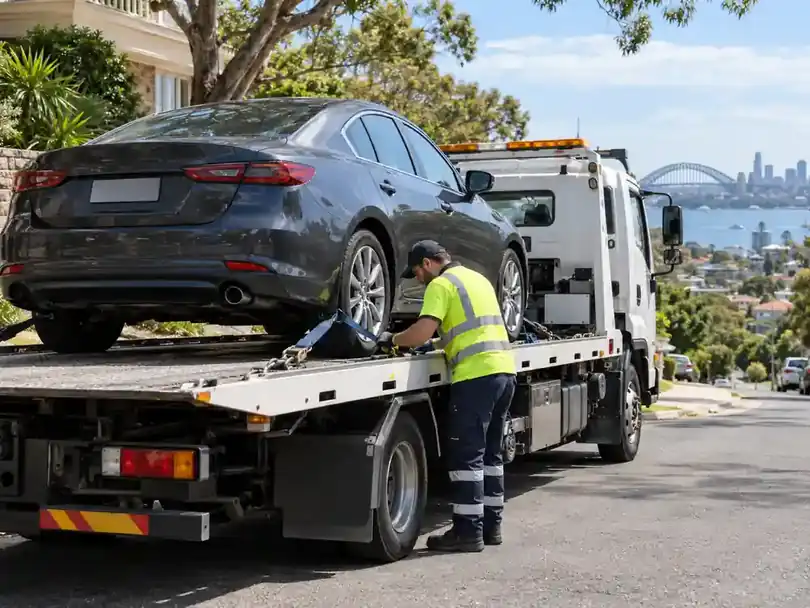
Consider professional towing when:
- The car’s manufacturer does not permit flat towing.
- The transmission or drivetrain has a fault.
- The steering, brakes or tyres cannot be relied upon.
- You do not have a suitable, approved A-frame.
- The towing vehicle does not have sufficient capacity.
- You are unsure whether the towing combination complies with NSW requirements.
- You need to move a non-running car to a workshop, home or another location.
A professional tow truck can transport a vehicle without requiring it to be flat-towed behind another passenger car.
AH Towing Services provides car towing in Sydney for breakdowns, non-running vehicles and planned vehicle moves, with tilt-tray transport available for suitable jobs.
Need a Car Towed in Sydney?
If your vehicle is unsuitable for A-frame towing or you do not have the correct equipment, AH Towing Services can help you arrange vehicle transport across Greater Sydney.
Tell the team your vehicle’s make and model, its condition, and where it needs to be collected and delivered.
Call AH Towing Services on 0420 502 202 to discuss your towing requirements and request a quote.
Frequently Asked Questions
Can you tow a car with a normal tow bar?
A conventional tow bar alone is not enough to flat-tow another passenger car. You need an appropriate towing system, such as an approved A-frame, along with compatible vehicles and equipment that meets relevant requirements.
Is it legal to tow a car with an A-frame in NSW?
A-frame towing is permitted under specified conditions in NSW. Transport for NSW’s published VSI 41 guidance covers engineering certification, braking, lighting, steering, registration and other requirements. Confirm the current approval requirements before towing.
Can you tow an automatic car with a tow bar?
Some automatic vehicles may be suitable for flat towing, but many have manufacturer restrictions. Selecting neutral does not automatically make towing safe. Check the exact vehicle’s owner’s manual before using an A-frame.
Can you tow a car with all four wheels on the ground?
Yes, this is called flat towing or four-wheel-down towing. It is only suitable when the vehicle manufacturer permits the procedure and the complete towing arrangement complies with the relevant requirements.
Do you need brakes on a car being towed with an A-frame?
Often, yes. NSW VSI 41 specifies mandatory operating brakes for towed vehicles with an overall mass or rated GVM of 750 kg or more. The braking system and its controls must meet the requirements applicable to the vehicle’s mass.
Can a small car tow a larger car with a tow bar?
Only if the actual loaded weight, towing capacity, coupling ratings and other applicable requirements allow it. Many small passenger cars do not have sufficient rated towing capacity to pull another car. Never judge suitability by engine power alone.
Can you reverse while A-frame towing?
Do not assume an A-frame system can be reversed. Reversing can place unsuitable forces on the towed vehicle’s steering and towing components. Follow the approved equipment manufacturer’s instructions; many setups prohibit reversing while connected.
Is a tow rope the same as an A-frame?
No. A tow rope or strap is a flexible connection, while an A-frame provides a rigid triangular connection between compatible vehicles. They have different handling characteristics, equipment requirements and legal considerations.
Is flat towing better than using a tow truck?
Flat towing can be suitable for a specifically approved vehicle and A-frame combination. A tow truck is generally more appropriate when the vehicle is not approved for flat towing, has mechanical problems or requires transport without its wheels rotating on the road.
Can I use an A-frame for long-distance towing in Australia?
A suitable approved combination may be used for longer journeys, subject to manufacturer instructions and applicable road rules. Check vehicle operating limits and the requirements of every state or territory on your route before travelling.


